

The Path Is The Goal, Yet Imperfect and Contradictory. Travel With Care.
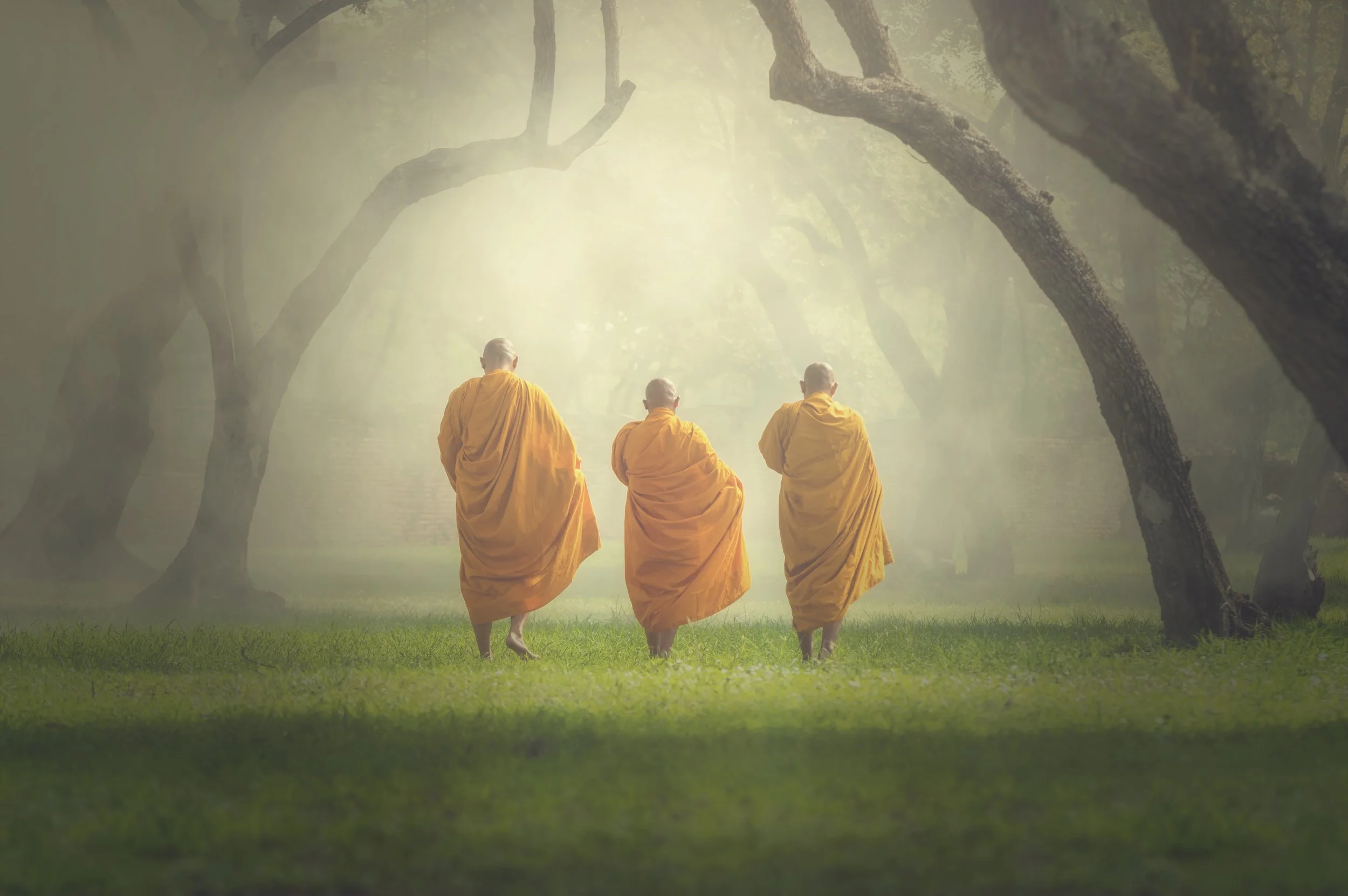
Monks hike in deep forest, photo by thananit_s
Welcome to the Crazy Wisdom Archives, a repository curated by our team at From The Ashes, intended to evoke thoughtful and meaningful insights on your journey of self-discovery and awakening, through the lens of the “Crazy Wisdom” lineage of Tibetan Buddhism.
The first post is titled in part after a book by Chögyam Trungpa Rinpoche, The Path Is The Goal: A Basic Handbook of Buddhist Meditation, a foundational guide to the “Crazy Wisdom” view. Trungpa’s style of teaching and his embodiment of the “guru” role was untraditional, controversial, and provocative to say the least. Yet he brings a kind of “cutting through” approach that makes the teachings very simple and accessible, at the same time that they remain mysterious and complex which is part of the richness of the path of learning - to explore this mysterious complexity.
At the heart of path, is the practice of meditation:
“According to the Buddha, no one can attain basic sanity and basic enlightenment without practicing meditation. You might be highly confused or you might be highly awakened and completely ready for the path. You might be emotionally disturbed and experiencing a sense of claustrophobia in relation to your world. Perhaps you are inspired by works of art you have done or the visual and audial aspects of works of art in general. You might be fat, thin, big, small, ntelligent, stupid — whatever you are, there is only one way, unconditionally, and that is to begin with the practice of meditation. The practice of meditation is THE and ONLY way. without that, there is no way out and no way in.” The Path Is The Goal, pg. 4
Later in the book, Trungpa describes the process of waking up along this path as a journey of understanding the mind, the emotions, and designing our own unique inner map of our way of being:
“The basic approach to understanding the mind is a process of gradually making friends with oneself. That is the first step.” The Path Is The Goal. pg. 66
So, the path is the goal, and that path is a process of befriending oneself. And meditation is the primary practice through which we uncover the way of forming an unconditionally loving bond with our self, and through this understanding, cultivating a deeper capacity for compassion toward ourselves, others, and the world.
And then what?
Well, to some degree, the inevitable next step is always to simply deal with the truth that arises along the way.
Some truths are liberating and revelatory. Other truths are confronting, uncomfortable, and even world-shattering.
Here, I want to confront and reveal some very uncomfortable truths at the outset of the Crazy Wisdom archives, relating directly to the lineage holders of this sacred path, and troubling allegations of misconduct and harm that have occurred from their actions.
It is a very human thing to edify one’s teachers as if they are infallible, perfect, and without fault. It is perhaps a necessary chapter for all beings on a path of awakening, to have a wake-up call about a teacher, guru, master, or spiritual friend, where a type of “fall from grace” occurs when certain shadows or harmful actions are brought to light.
There is no shortage of examples of gurus and teachers misusing their positions of power to cause harm and abuse for their students. In light of this uncomfortable truth, and in an effort to address clearly the problematic behaviors and allegations that exist here in the Crazy Wisdom lineage, I have provided links below regarding allegations, known concerns, and other issues for each of you to explore in your own way in your own time.
It is complicated to separate the teacher from the teachings, especially when there is misconduct alleged or proven. In every case, spiritual teachings required that students exercise deep discernment to choose how to integrate teachings into your own journey. It is important to face the whole truth, especially the uncomfortable parts, most importantly when these issues intersect with aspects of our sacred inner awakening journey, while also confronting our internal sense of ethics, morality, or justice.
In the documentary about Trungpa’s life, Crazy Wisdom, reknowned author and spiritual teacher, that was a senior student of Trungpa’s, Pema Chodron, in reflecting on the well-known alcoholism and other seemingly inappropriate behaviors of Trungpa, says,
“People say to me, ‘how could you follow a teacher like that?’ or ‘how could an enlightened person do that?’… I do not know… I can’t buy a party line where I ‘it was sacred activity’ or something like this, come up with ground to make it okay. I also can’t come up with ground, or fixed idea to make it not okay. You know, I’m left, really left, in that, ‘I don’t know, I don’t know,’ but I can’t answer the relative questions because he defied being able to answer them.”
This quotation in many ways, captured the ineffable, uncertain, groundless, and contradictory reality that was at the heart of Trungpa’s teachings, and the “Crazy Wisdom” lineage as a whole. It seems safe to assume that Trungpa was quite a degree more wild and untethered to decorum and norms of what is “acceptable” in a spiritual teacher, than his Tibetan forebears - yet, there are quite many stories of radically wild, unbelievable, and difficult to accept situations, actions, and behaviors of highly regarded monks and teachers throughout the Crazy Wisdom lineage, and other schools and sects as well.
All this to say, that the life and teachings of Chögyam Trungpa Rinpoche, and the lineage of Crazy Wisdom that he left in his wake, and that a number of teachers and practitioners continue sharing to this day, is rife with contradiction, and requires a deep and unwavering commitment to one’s own inner subjective discernment, and relationship to truth, integrity, and awakening, to follow such a path. For there is not in any way shape or form, a leader, teacher, or guru that has an unassailable character, that can be trusted as an beacon of enlightenment to be emulated and followed. Much to the contrary, quite the opposite is true.
Even the Dalai Lama, who in many respects does emanate a certain perfection of character in how he carries himself, the actions he takes, and the way in which he embodies an enlightened way of being - was mired in scandal in 2023, when he was captured on camera in an intimate moment with a young Tibetan child, where he kissed the child on the cheek, then pulled him by the chin to keep his lips, and while forehead-to-forehead, jokingly said to the child “suck my tongue”. Many accused the spiritual leader of inappropriate behavior for this moment. Others defended the action as part of the Dalai Lama’s well-known joking demeanor, and clarified that sticking out one’s tongue is a well-known culturally appropriate greeting in the Tibetan culture. Though it was also noted the phrase “suck my tongue” is not in any way part of that cultural tradition.
All of this is shared, in the spirit of transparency and informed consent, so that each reader and practitioner can use their own discernment to find a path, a set of teachings, and teachers that resonate with their own path.
Trigger Warning: The section below, and particularly the linked documents, discuss allegations and incidents of spiritual, emotional, and sexual abuse, and other forms of manipulation that may be triggering to sensitive readers.
Chögyam Trungpa Rinpoche
An excerpt from the article Encountering the Shadow in Buddhist America, by Katy Butler, published in Common Boundary Magazine in 1990, describes Trungpa Rinpoche’s controversial view and teaching methods well:
“Trungpa Rinpoche, the 11th incarnation of the Trungpa Tulku. was the teenage head of several large Tibetan monasteries when the 1959 Chinese invasion tore him from his native culture. Eager to meet the West on its own terms, he gave up his robes for a business suit, fell in love with Shakespeare and Mozart, and married an English woman. He sometimes lectured with a glass of sake in his hand.
Trungpa Rinpoche taught that every aspect of human existence–neurosis, passion, desire, alcohol, the dark and the light–was to be embraced and transmuted. He called his wild approach “crazy wisdom,” referring to a small but genuine tradition of revered, eccentric Tibetan yogis–most of whom worked intimately with one or two students…Yet woven into the discipline and creativity was a strand of hedonism. Vajradhatu students had a reputation for the wildest parties in Buddhist America. Although most Tibetan Tantric schools clearly discourage “acting out” passions and impulses, Trungpa Rinpoche did not. In fact, drunk and speeding, he once crashed a sports car into the side of a joke shop and was left partly paralyzed. He openly slept with students. In Boulder, he lectured brilliantly, yet sometimes so drunk that he had to be carried off-stage or held upright in his chair.”
The article is a quite devastating exposé on the abusive and harmful shadows that existed beneath the surface of the east-meets-west explosion of Buddhism in the USA throughout the 70’s and 80’s as Trungpa’s Crazy Wisdom lineage took root and flourished in the West. I encourage all aspiring Buddhists to read this article, and other journalism and essays that you encounter about these events. It is a troubling but deeply important thread of truth within the lineage - and unfortunately a common element that seems to emerge from nearly all spiritual communities over time.
Trungpa, while he is rightly revered as a phenomenal practitioner and teacher of Tibetan Buddhism, was also well known to be an alcoholic and womanizer that openly engaged in sexual relationships with multiple students, and facilitated many questionable events and situations that caused harm to participants, and could rightfully be described as abusive, manipulative, and intentionally harmful.
Perhaps most egregious, was that Trungpa’s “Regent” Ösel Tendzin (Thomas Rich), who assumed the mantle of lineage holder and leader of the Crazy Wisdom community following Trungpa’s sudden death in 1987, was known by Trungpa to be infected with the AIDS virus, up to 1-2 years before Trungpa’s death, and yet no efforts were made to restrict his known sexual relations with students, or to warn or protect students in the aftermath of Trungpa’s death, and the Regent’s ascent to leadership.
As the article linked above exposes in detail, there is a clear pattern of denial, secreting away shameful behaviors, and scapegoating disgraced teachers while attempting to carry on business as usual in the wake of a fall from grace.
Another article titled, “Survivors of an International Buddhist Cult Share Their Stories” contains a deeply impactful investigative series that includes first person accounts of those that were affected by the energy and movement surrounding Trungpa through the years, and the cultural dynamics that attributed to the phenomena.
Sakyong Mipham Rinpoche
While I have not personally studied the work of Sakyong, or followed the Shambala International communities teachings directly, my studies of Trungpa Rinpoche’s work, and his role as a founder of Shambala, and having named Sakyong as his heir, make it necessary to address the sexual assault scandal that rocked Shambala in 2018 due to allegations against Sakyong.
The eldest son of Chögyam Trungpa Rinpoche, Sakyong was named heir to the Shambala lineage in 1979 at the age of 17. When Trungpa died in 1987, the leadership of the lineage was carried on first by Trungpa’s regent Ösel Tendzin, and was passed on to Sakyong in 1990 after Tendzin’s death from AIDS.
In 2018, following a series of sexual misconduct allegations, Sakyong agreed to step back from his leadership and teaching at Shambala International, however he resumed teaching in 2019 until an impasse in 2022, at which time he stepped away from the Shambala organization and moved to Nepal where he continues to teach an international sangha.
This article from 2019 in the Denver Post, outlines Sakyong’s controversial biography and questionable ascension to his status as a global leader of the spiritual tradition. This article profiles the Shambala student and survivor that broke the sexual assault story that lead to Sakyong’s fall from grace. The student, Andrea Winn, when on to create Buddhist Project Sunshine in her efforts to raise awareness, bring accountability, and create a restorative healing and justice initiative for the Shambala community. She has release three detailed reports available on her website that are succinctly summarized in this 11-slide presentation.
In 2020, shortly after Sakyong resumed his teaching and leadership at Shambala in the wake of the allegations, reknowned Buddhist teacher and author Pema Chödrön issued her letter of resignation as an Acharya, or revered senior spiritual teacher and master, of the Shambala community.
Dr. Reggie Ray
Reggie Ray was a senior student of Chögyam Trungpa Rinpoche from 1970 until Trungpa’s death in 1987. He was a founding teacher of Trungpa’s Naropa University, and a senior teacher for Shambala International from 1996 to 2004. He left Shambala in 2004 and founded Dharma Ocean in 2005, to continue his work as teacher of the Crazy Wisdom lineage. In Reggie’s own words, his separation from Shambala was necessary because of certain rigidity and constraints that were placed on teachers at Shambala, which Reggie believed were not in alignment with the lineage he received from Trungpa.
Reggie is a self-proclaimed “lineage holder” of the Crazy Wisdom Tibetan Buddhism tradition, which has been a source of controversy by some traditional practitioners and teachers. Reggie addresses these issues in some of his Dharma Ocean podcasts, and writings, by saying that Trungpa himself claimed that there was no required ritual, ceremony, or transmission to become a lineage holder, that it was a sacred duty that could be self-proclaimed - which Trungpa himself also did so in a way, after he was disrobed and stripped of his official titles and roles after breaking rank in his unorthodox teaching methods after he relocated to the West.
In 2019, a group of former Dharma Ocean members including several senior students and meditation instructors, issued an Open Letter on Abuse in Dharma Ocean. The letter was the first of several public correspondences from senior students, teachers, and members of the Dharma Ocean community, and responses from Reggie, regarding the allegations of abuse.
The core allegations are regarding Reggie’s treatment of senior students, which are described as emotional and spiritual abuse, and accuse Reggie of Narcissistic Abuse, such as grooming, love bombing, gaslighting, public humiliation, and manipulation. The letters highlight the problematic dynamic wherein Reggie served as both the Spiritual Director and Managing Executive, and thus there were no accountability mechanisms in place to effectively address alleged misconduct and patterns of abuse. The quote from the initial open letter below summarizes some of the key problematic dynamics:
”In his relationships with close students, Reggie was constantly repeating a cycle: scathing verbal abuse, quickly followed by love-bombing, then distancing, and inevitably lashing out again, over often small transgressions. When a senior student would leave, having endured emotional and spiritual abuse for many years, Reggie’s narrative would often center his own feelings of betrayal and hurt, or portray calculated indifference. Having witnessed others disappear from the organization and be publicly and privately disparaged by Reggie Ray, at times even from the teacher’s seat during a retreat, most of us feared that fate. It was painfully obvious that if or when we left, whatever we did or said to him or others would be used against us for his purposes of controlling the narrative. Any attempt to counter or even discuss a narrative Reggie had formed of you, most often based on incomplete information gathered from others, would be regarded as being “dramatic,” “just your ego talking,” “territorial,” or “controlling the space.””
This issue has been quite confusing and confronting for me personally, as Reggie was my primary teacher along the Buddhist path. I took Refuge Vow from Reggie as part of the annual Dathun retreat in Crestone, CO in 2016, and I took Bodhisattva Vow with one of Reggie’s senior students, Neal McKinley in 2018. Neal was one of the students that left Dharma in the wake of the open letter, and hosted a community zoom call months later to explain in depth his personal experiences with the problematic behavior, and to explain how he related to the situation and determined it was best for him and his students to leave Dharma Ocean and share his experiences.
Closing Message
These situations have necessitated deep introspection for me, and have been quite difficult to navigate and integrate.
In my early days of exploring and learning about Buddhism, I was delighted at how the teachings resonated so deeply with my search for inner truth, and a way to relate to the confusion and contradiction in my mind, heart, and experiences. As I deepened into the teachings of Reggie Ray at Dharma Ocean, I was a bit confused to learn about Trungpa’s various behaviors, alcoholism, and harm caused to students. It seemed that Reggie and the senior students had made their peace, and integrated these situations into teachable moments for the carrying on of the tradition.
I didn’t experience any of the teachers or senior students attempting to explain away, or make okay, these situations. Yet it was complicated. As I researched more deeply, I learned about the AIDS scandal of the Regent that succeeded Trungpa, and uncovered other troublesome situations and it gave me pause deeply on my path.
At the same time, I continued reading, Trungpa’s teachings, listening to and watching his talks, and integrating the dharma he shared. While it was saddening to learn about the harm caused, it was liberating in a sense to learn that he was quite open and transparent about these behaviors that were not aligned with the cultural, ethical, and moral norms of my world - and how he seemed to be quite intentional about his own imperfections, and on a quest to liberate through transmutations, these elements of shadow.
None of this is to excuse the harmful actions, but to clarify the depth of contemplation in my process of making peace with the truth of all that is - not just the good parts that feel nice to believe and understand.
There was also a sense of these situations occurring decades ago, and being of a different time, on the heels of the flower power sexual and substance-related liberation movements - so it seemed a bit of a relic of the past.
When the scandals emerged in succession with Sakyong and Reggie, while the Zeitgeist was politically charged in the #metoo and #timesup movement, I was shaken again to my core.
To this day, I have mixed feelings about Reggie and Dharma Ocean, and I am unlikely to participate in future programs or events that Reggie hosts, or to support Dharma Ocean directly. But I cannot justify in my heart, throwing away my access to and pursuit of the teachings of Trungpa or Reggie, because to this day, the teachings and practices continue to prove themselves as a meaningful refuge for my heart and soul in times of otherwise unbearable inner and outer chaos.
And such is the teaching of Crazy Wisdom. That all mind states are workable. That all beings arise out of a state of basic goodness. That all obscurations of awakening, that present as misbehavior, immoral, etc. are opportunities to wake up more fully to the fullest, truest, most unvarnished state of reality which exists in our world.
So I continue my own journey of discernment, and I will continue to do my best to transparently acknowledge the imperfections. problems, and contradictions that exist on this path of awakening that I choose to follow.